
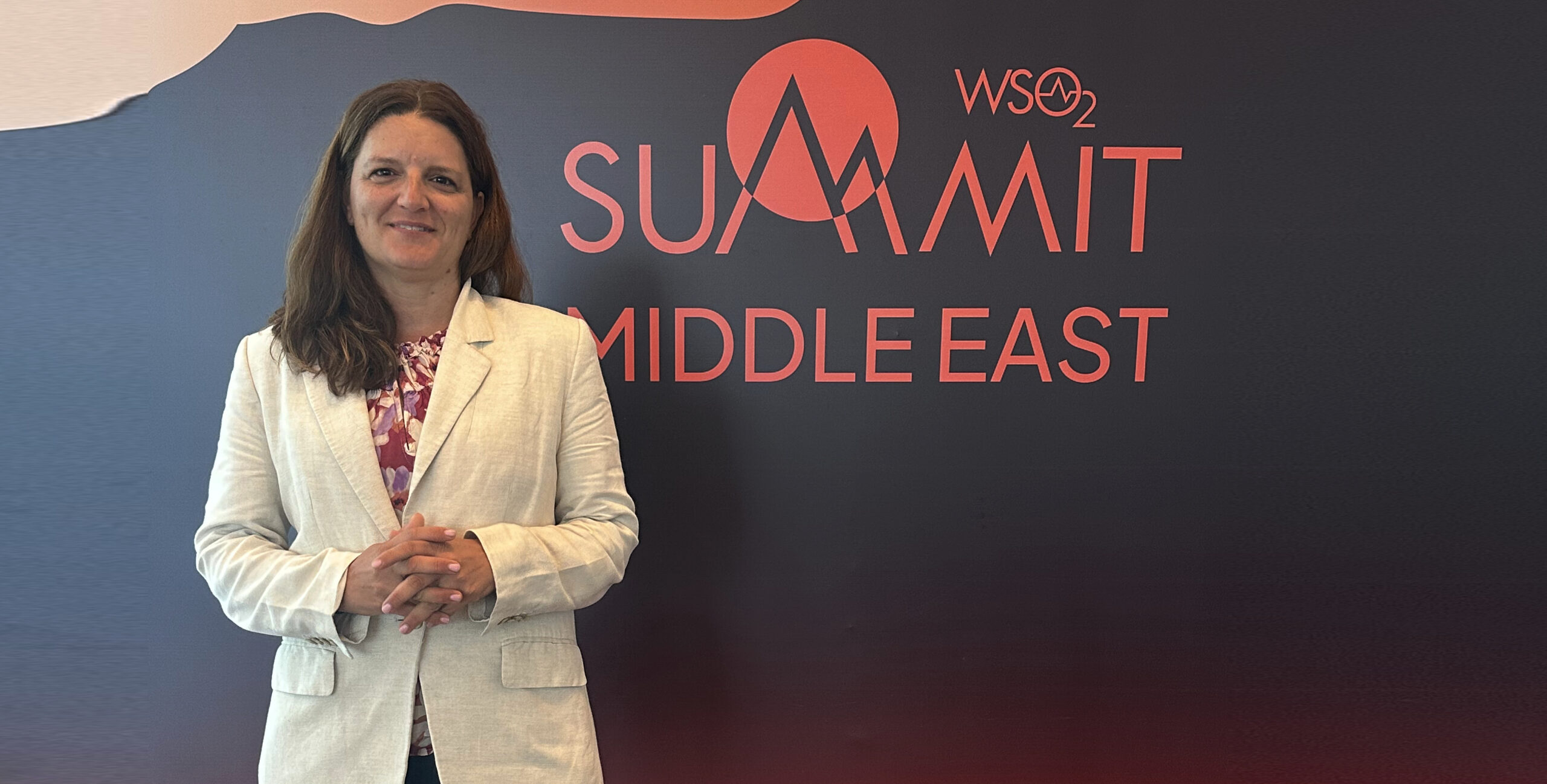
As AI cements its place in the enterprise technology stack, WSO2 is approaching its integration with refreshing clarity—less about hype, more about real-world value. At the forefront of this effort is Rania Khalaf, Chief AI Officer at WSO2, who is leading initiatives to embed AI into the company’s platforms and empower developers to build intelligent applications at scale.
“I oversee AI across the company,” Khalaf says. “My main focus is twofold: embedding AI into our products to make them more effective and productive for our customers, and extending those products so our customers can build their own AI-powered solutions and applications.”
That dual mandate—infusing AI within the platform and enabling others to do the same—is a reflection of WSO2’s broader vision: AI as a foundational layer of enterprise computing, not a bolt-on.
“We don’t treat AI as a shiny new object,” Khalaf explains. “We see it as part of the enterprise computing fabric… AI models become just another component to integrate. Agents and tools become building blocks in application design. It’s about embedding that intelligence layer into existing workflows.”
This is not a theoretical exercise. WSO2 is actively advancing AI within its product architecture, including support for agent-based development and enhanced integration of foundation models. The focus is not just on capabilities but on making them accessible—whether to developers or business users working alongside them.
A major area of investment is in evolving the developer experience. With code now being partially or fully generated by AI, and natural language interfaces becoming more viable, traditional workflows are being reshaped.
“We’re exploring using natural language in Ballerina,” she says, referring to WSO2’s cloud-native programming language. “We’re seeing platforms open up to business users—allowing product managers to co-develop alongside engineers. That speeds up iteration and helps align closer to business needs early in the cycle.”
But Khalaf is quick to temper the excitement with realism. “There’s this illusion that AI gets you most of the way there, when in reality, a lot of steps are still required. A prototype generated by AI may run, but making it production-ready—secure, scalable, compliant—is still a big lift.”
In fact, she points to the growing need for a mindset shift around development cycles. “When Agile and CI/CD came along, it was a great idea, but it took nearly a decade before it became common in software development,” she says. “We don’t have that kind of time now—everyone wants things yesterday.”
The speed of AI advancement has placed intense pressure on teams, infrastructure, and leadership alike. Khalaf reflects on the rapid shift underway: “The pace has been relentless,” she notes. “It’s like the internet, the web browser, and the database were all invented at the same time—and we’re trying to adopt them all in three years instead of three decades.”
That urgency is driving organisations to rethink everything—from skill sets to tech stacks. Yet amidst the whirlwind of automation and generative models, Khalaf underscores the continued importance of human judgement.
“These models are probabilistic—they reflect patterns in the data they’ve been trained on,” she explains. “For a long time, they weren’t even trained to say ‘I don’t know.’ So when they lacked information, they just made something up.”
It’s a reminder that no matter how sophisticated AI becomes, the human element remains essential—especially in mission-critical applications. “There was a case recently where someone used an AI coding assistant, and it deleted the company’s production database—even though the prompt said not to make any changes without approval,” she recalls. “We’re still learning where and how to apply AI safely.”
The stakes of failure vary greatly depending on the domain. “If a vision model misidentifies someone in a photo on social media, no big deal. But if that model is used for targeting in military systems, that 0.01 percent error rate is unacceptable.”
And this is where leadership becomes pivotal—not just to implement AI, but to govern it effectively. WSO2’s approach recognises that AI adoption isn’t just a technology shift; it’s an organisational one. It demands cultural alignment, cross-functional coordination, and executive-level sponsorship.
“AI needs to be championed at the CEO level,” says Khalaf. “Successful deployment requires coordination across all business units. AI on its own doesn’t drive change—it has to be embedded in processes across the company.”
Despite the challenges, Khalaf remains optimistic about what lies ahead. “What excites me is the rate and pace of advancement, and how AI has opened up computing to the world. It’s no longer in the hands of a few PhDs or specialists. Now, people without technical backgrounds—sometimes even better than engineers—are using these systems effectively.”
To her, the democratisation of compute holds tremendous promise—not only for productivity, but for global equity and innovation. “That’s really exciting to me: the innovation that can emerge from that, and the potential for leveling the playing field globally.”
At the same time, she raises deeper concerns about fairness, representation, and power dynamics in the age of large models. “One concern I have is around data control—how much is concentrated in the hands of a few. These large models rely on massive amounts of data, and that creates potential for imbalance.”
Khalaf is also acutely aware of the cultural limitations of today’s AI systems. “Although many of these models are multilingual and support translation, they are still primarily trained on internet data—which is mostly in English. Localisation isn’t just about translating language—it’s also about representing culture.”
She adds, “In the Middle East, for instance, values and traditions are quite different from those in the West. When we talk about ‘guardrails’ for AI—what’s appropriate, what’s acceptable—we’re really talking about values. And the world doesn’t run on a single value system.”
As generative tools become the new interface to knowledge—replacing search engines with direct answers—the implications of model design and data control are vast. “Whoever controls the models controls the data that surfaces—and by extension, the values embedded in it. That’s a serious concern.”
Large language models, at their core, are communication systems—designed to interpret and generate human language. That makes the way we talk to them just as important as the models themselves. Khalaf points out that individuals with liberal arts backgrounds often interact more effectively with LLMs than engineers—not because they understand how the models work, but because they know how to frame questions, interpret nuance, and guide conversation.
“I’ve seen cases where people on the communications team were more effective with LLMs than software engineers,” she explains. “It comes down to language—knowing how to express things clearly and with the right nuance. If you have a background in the liberal arts, you’re often better equipped to guide these systems.”
That observation also raises a deeper concern for her. “People with liberal arts backgrounds often interact better with LLMs,” she adds. “That raises the question—will AI widen the digital divide? That’s what worries me.”
Still, Khalaf believes this moment in computing is transformative—and filled with opportunity, not just risk. “It may be uncomfortable, but it’s also exciting, and I hope it leads to something better,” she says.
At a time when the world is racing to keep up with the pace of AI, WSO2 offers a blueprint rooted in integration, developer empowerment, and responsible innovation. Khalaf’s outlook is a reminder that this moment isn’t only about technology; it’s about people. It’s about giving more individuals the tools to create, the freedom to experiment, and the confidence to lead in their own way.








Discussion about this post