
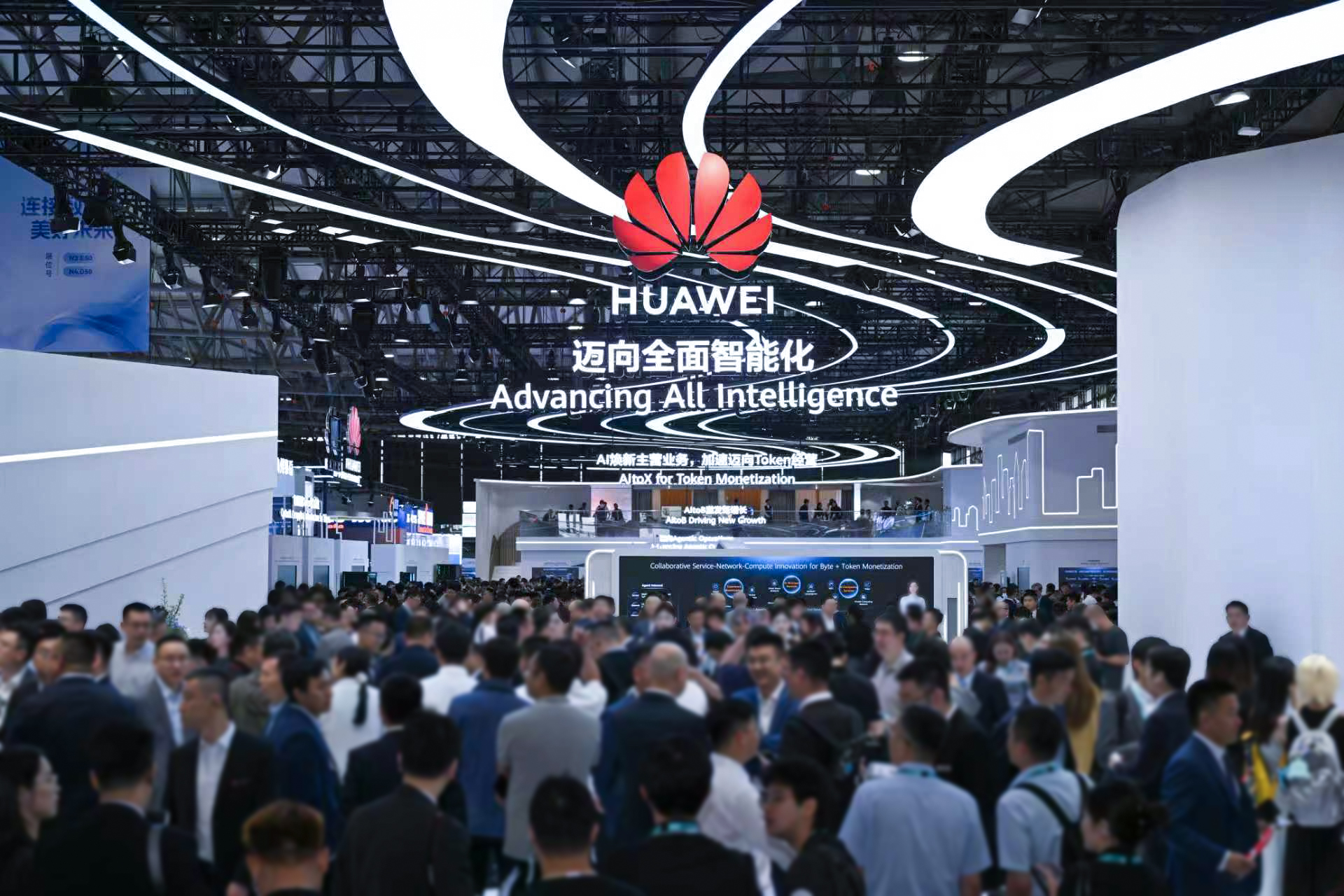
Huawei set out its vision for the next decade of mobile communications at Mobile World Congress (MWC) Shanghai 2026, while highlighting the Middle East’s growing strategic role as the industry transitions toward AI-native networks and a new era of token-based connectivity.
Held under the theme “Advancing All Intelligence,” MWC Shanghai 2026 brings together global carriers, industry partners and key opinion leaders to explore enhanced connectivity and compute, 5G-A high uplink and experience monetisation, and AI-powered business upgrade.
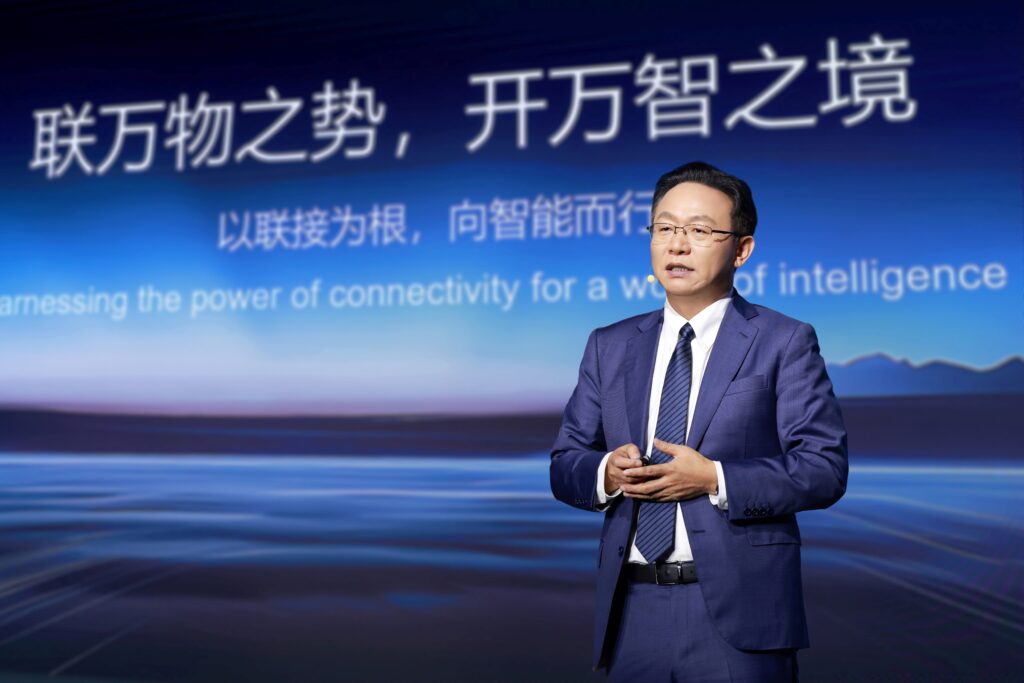
At the event, David Wang, Huawei’s Deputy Chairman of the Board and Rotating Chairman, delivered a keynote address on how AI is reshaping the economics of mobile communications and setting the direction for the next decade of industry growth.
On spectrum, Wang said securing the right frequency resources is essential to delivering the performance that AI-driven services will require. The U6GHz band, the most strategically important slice of spectrum for the next phase of mobile communications, has already been formally designated for International Mobile Telecommunications (IMT) by more than 20 countries and regions, covering nearly 80% of the global population. He said operators will need to secure continuous bandwidths of 200 MHz to 400 MHz or more to deliver capabilities including five times downlink, ten times uplink, and low-latency, high-reliability performance.
In his keynote, Wang said that AI is fundamentally changing what mobile networks must be capable of delivering, and that the decisions operators and governments make in the next 12 to 18 months will determine who leads and who follows in the global race toward intelligent connectivity. “With each generation, we have pushed the limits of spectral efficiency and performance. This has consistently expanded the boundaries of communications, helping carriers translate network capabilities into commercial value,” Wang said.
He cited Huawei projections showing that the number of AI agents operating worldwide is expected to exceed 100 billion by 2030 and could reach the trillions by 2040. In the most densely connected urban environments, agent density is projected to surpass 10 million per square kilometer. Wang noted that global 5G subscribers have already crossed 3.1 billion, and that China’s 5G-Advanced user base alone has surpassed 110 million. The imperative for the industry, he added, is to ensure that mobile networks evolve at a pace that matches the demands AI will place upon them.
Token economy, innovations and real-world applications
At MWC Shanghai 2026, Huawei introduced its concept of the token economy, where tokens, the fundamental unit of output in large language models and AI services, are becoming the new measure of value in mobile communications. As AI agents become embedded across industries, Huawei said supporting token production, transmission and consumption at scale is rapidly becoming a core network differentiator for operators.
Huawei unveiled its AI-centric target network at the event alongside China’s three major carriers. The architecture is built across three integrated layers: a communications network designed for real-time interaction rather than traffic throughput; a computing network in which access to the network becomes functionally equivalent to access to computing resources; and an AI computing infrastructure anchored by Huawei’s SuperPoDs, designed for high-efficiency token production with open-source compatibility and a storage-compute integration that the company said reduces cost per token and improves output per watt.
High uplink: A critical capability for the AI era
Huawei highlighted uplink performance as one of the most critical technical requirements of the AI era. Mobile networks have historically been designed to prioritise downlink capacity, reflecting the consumption-heavy patterns of video streaming and browsing. AI-driven applications are changing that equation significantly. AI glasses already in use for real-time translation and visual assistance require 20 Mbps of uplink throughput. As multimodal AI applications continue to scale, Huawei said that 1 Gbps peak uplink capacity and 20 Mbps as a universal uplink baseline are becoming the new benchmarks that operators must plan around.
AI-native networks in action
The transformative potential of AI-native networks is already being demonstrated across multiple industries. In Singapore, Singtel’s deployment of agentic AI in customer operations saw its AI assistant handle more than 70,000 customer interactions in six weeks, with 70% of routine queries resolved without human involvement, freeing employees to focus on higher-value and more complex customer needs.
In China, firefighting robots equipped with 5G-Advanced modules are operating on the frontline of emergency response, using China Mobile’s network to stream real-time thermal imagery to cloud-based AI systems that support fire source localisation, remote piloting and autonomous execution in complex scenarios.
In logistics, AI agent networks have demonstrated the ability to cut shipment delays by 15% by replanning delivery routes in real time during weather disruptions, processing hundreds of route alternatives in seconds. In the consumer segment, Huawei’s Celia assistant is recording three billion daily activations, reflecting a 4.5-fold increase in agent distribution and illustrating the scale of AI interaction that next-generation networks will be required to support.
A spectrum opportunity with regional significance
With the Middle East expected to be the first region in the world to deploy a commercial 5G-Advanced network running on U6 GHz, and selected carriers in Hong Kong and Macao of China also set to begin commercial deployment later this year, Huawei sees the region as uniquely positioned to lead the next phase of global mobile communications.
For operators across the Gulf Cooperation Council (GCC) and the wider Middle East, Huawei believes this represents a significant strategic opportunity. Carriers in the UAE, Saudi Arabia and neighboring markets have been among the most progressive globally in deploying advanced 5G networks, and U6 GHz would enable them to unlock substantially higher bandwidth to support the real-time, AI-driven applications that are placing increasing demands on uplink capacity.
A vision for 2035
At the concurrent Mobile Broadband Forum (MBBF) Top Talk Summit, held in Shanghai on June 23 and attended by 150 industry figures including mobile telecom operators, AI ecosystem leaders, industry organisation representatives and leading academics, Li Peng, Huawei’s Director of the Board and President of ICT Sales and Service, set out the company’s longer-term vision for the decade ahead.
“By 2035, we’ll have co-created an Agentverse defined by carbon-silicon symbiosis, virtual-real integration, and agent collaboration,” Li Peng said. “Intelligent connectivity can break new boundaries; technological innovation can open the door to new network capabilities; and the intelligent economy can unlock new value in connectivity. Together, we can achieve symbiosis with AI, advance with AI, and succeed with AI.”
Li Peng concluded by inviting global carriers and industry partners to collaborate with Huawei in building what he called a Mobile AI City, and in shaping the next decade of mobile communications.
Framework for mobile communications governance
Huawei is committed to play a central role in shaping the 3GPP Release 21, the standards framework that will govern mobile communications from 2030 to 2040, which is expected to launch in March 2027. The company will work closely with carriers, industry partners and governments to translate the priorities outlined at MWC Shanghai into practical progress.
As the ICT industry moves rapidly toward an era of token monetisation, Huawei is working with global carriers and partners to explore 5G-A high uplink and experience monetisation, as well as AI-powered business upgrade, through enhanced connectivity and compute.
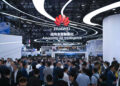
MWC Shanghai 2026 takes place from June 24 to 26 in Shanghai, China. During the event, Huawei is showcasing its latest products and solutions in Hall N1 of the Shanghai New International Expo Centre (SNIEC).





Discussion about this post