

• About Us
  • Advertising
  • Digital Magazine
  • Supplements
  • Media Pack
  • Privacy Policy
  • Contact us
CXO Insight Middle East
  • News
  • Opinion
  • Business
    • Industries
      • Transport
      • Retail
      • Government
      • Real Estate
      • Education
      • Energy
      • Banking and Finance
    • Channel
  • Future
    • Tech
    • Gadgets
    • Science
    • Space
    • Sustainability
  • Events
    • Channel Awards
      • 2025
      • 2024
      • 2023
    • Channel Insights Summit 2025
    • Insight Innovation Summit
    • CXO50 Oman
    • CXO50
      • 2026
      • 2025
    • ICT Awards
      • Dubai 2025
      • Saudi Arabia
    • Cyber Strategists Summit
    • Cloud Connect 2025
    • All events
  • Digital Magazine
  • GITEX GLOBAL
No Result
View All Result
CXO Insight Middle East
  • News
  • Opinion
  • Business
    • Industries
      • Transport
      • Retail
      • Government
      • Real Estate
      • Education
      • Energy
      • Banking and Finance
    • Channel
  • Future
    • Tech
    • Gadgets
    • Science
    • Space
    • Sustainability
  • Events
    • Channel Awards
      • 2025
      • 2024
      • 2023
    • Channel Insights Summit 2025
    • Insight Innovation Summit
    • CXO50 Oman
    • CXO50
      • 2026
      • 2025
    • ICT Awards
      • Dubai 2025
      • Saudi Arabia
    • Cyber Strategists Summit
    • Cloud Connect 2025
    • All events
  • Digital Magazine
  • GITEX GLOBAL
No Result
View All Result
CXO Insight Middle East
No Result
View All Result

DDoS Attacks Tripled On Educational And Muncipal Sites In Q1: Kaspersky

by CXO Staff
May 11, 2020
in News

The Kaspersky Q1 2020 DDoS attacks report has revealed the overall number of attacks grew during the first three months of this year.

DDoS security

The Kaspersky Q1 2020 DDoS attacks report has revealed the overall number of attacks grew during the first three months of the year, with a significant spike in attacks on municipal and educational sites. This can be due to the fact that DDoS actors are taking advantage of the current situation when people are locked down in their homes and are heavily reliant on digital resources.

The coronavirus pandemic, beginning in the first quarter of 2020, has caused almost all activities – be it learning, work, or leisure – to shift online. The increased demand in online resources was noted by cyberattackers, who conducted attacks on the most vital digital services or those that are growing in popularity. For instance, the US government’s Department of Health and Human Services, a group of hospitals in Paris, and servers of an online game were all targets of DDoS attacks in February and March.

Kaspersky’s Q1 2020 DDoS attacks report also revealed notable growth in attacks on educational resources and cities’ official websites. In Q1 2020, this number tripled compared to the same period in 2019. The share of such attacks amounted to 19% of the total number of incidents in Q1 2020.

Kaspersky experts suggest that the growth in attackers’ interest is caused by the fact that people are becoming more reliant on these online resources remaining stable and accessible during the outbreak. If they have seen conflicting messages about the virus and what preventive measures can be taken, people may look at official sources of information for more assured guidance. Many schools and universities have also shifted to online lessons.

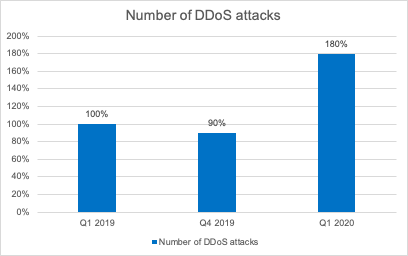
In general, the total amount of DDoS attacks in Q1 2020 has increased as well. During this period, Kaspersky DDoS Protection detected and blocked double the amount of attacks than in Q4 2019, and 80% more in comparison with Q1 2019. The average duration of attacks also grew: in Q1 2020, a DDoS attack lasted 25% longer than in Q1 2019.
Kaspersky DDoS“Outage of internet services can be especially challenging for businesses now, because this is often the only way to make goods and services available to their customers. In addition, widespread adoption of remote working opens new vectors for those responsible for carrying out DDoS attacks. Previously most attacks were conducted against the public-facing resources of companies. We now see that DDoS attacks target internal infrastructure elements, for example, corporate VPN gateways or email servers,” said Alexey Kiselev, Business Development Manager on the Kaspersky DDoS Protection team.

To help organisations protect themselves from DDoS attacks while staff work from home and during significant spikes in attackers’ activity, Kaspersky recommends taking the following measures:

  1. Do not panic. Unexpected traffic peaks may look like a DDoS attack, but these instances can be caused by legitimate users. They can visit resources which were not as popular before, at times they were not previously accessing them.
  2. Conduct a fault tolerance analysis of your infrastructure to identify weak nodes and increase their reliability. Attack vectors and traffic peaks are changing, so some resources may work unstably.
  3. Consider DDoS protection for your non-public services. Their importance to business continuity may increase, making them a target for malefactors.

Tags: Alexey KiselevDDoSeducationfeatured1KasperskyUAE
ShareTweet

Related Posts

Anthropic & ServiceNow unveil deeper integration with Claude
Business

Anthropic & ServiceNow unveil deeper integration with Claude

February 2, 2026

ServiceNow and Anthropic have announced a collaboration to further integrate Anthropic Claude models into core ServiceNow workflows for application development...

Vertiv brings AI Innovation Roadshow to Riyadh
Business

Vertiv brings AI Innovation Roadshow to Riyadh

January 30, 2026

Vertiv announced the launch of its 2026 AI Innovation Roadshow events. Kicking off in Riyadh on January 26 in collaboration...

Discussion about this post

Latest Issue

Anthropic & ServiceNow unveil deeper integration with Claude

Anthropic & ServiceNow unveil deeper integration with Claude

February 2, 2026
Vertiv brings AI Innovation Roadshow to Riyadh

Vertiv brings AI Innovation Roadshow to Riyadh

January 30, 2026
From ‘what?’ to ‘why?’ How full-stack observability is moving developers past application monitoring

Palo Alto Networks completes Chronosphere acquisition

January 30, 2026

The most trusted source of strategic intelligence for IT decision makers in the Middle East.

About

  • About Us
  • Advertising
  • Digital Magazine
  • Supplements
  • Media Pack
  • Contact Us

Policies

  • Privacy Policy
© 2025 – CXO Insight Middle East. All Rights Reserved.
Facebook-f X-twitter Linkedin
Separated they live in Bookmarksgrove right at the coast of the Semantics, a large language ocean. A small river named Duden.

About

  • About Us
  • Site Map
  • Contact Us
  • Career

Policies

  • Help Center
  • Privacy Policy
  • Cookie Setting
  • Term Of Use

Join Our Newsletter

© 2024 – CXO Insight Middle East. All Rights Reserved.

Facebook-f Twitter Youtube Instagram

Welcome Back!

Login to your account below

Forgotten Password?

Retrieve your password

Please enter your username or email address to reset your password.

Log In
Join our mailing list
Sign up here to get the latest news, updates and special offers delivered directly to your inbox.
No Result
View All Result
  • News
  • Opinions
  • Business
    • Industries
      • Transport
      • Retail
      • Government
      • Real Estate
      • Education
      • Energy
      • Banking and Finance
  • Channel
  • Future
    • Tech
    • Gadgets
    • Science
    • Space
    • Sustainability
  • Events
    • Channel Awards
      • 2025
      • 2024
      • 2023
    • Channel Insights Summit 2025
    • Insight Innovation Summit
    • CX50 Oman
    • CXO50
      • 2026
      • 2025
    • ICT Awards
      • Dubai
      • Saudi Arabia
    • Cyber Strategists Summit
    • Cloud Connect 2025
    • All events
  • Videos
  • GITEX GLOBAL
  • Digital Magazine

© 2025 - CXO Insight Middle East. All Rights Reserved.