
At a time when industrial software has become the backbone of global transformation, AVEVA is redefining how data, AI and digital twins drive operational efficiency and sustainability. In a conversation with Khaled Salah, Global Vice President – Strategic Partners, AVEVA, he outlines how the company’s integration within Schneider Electric’s ecosystem is enabling industries to extract value from trusted data, achieve meaningful efficiencies, and build for the future with confidence.
“AVEVA is an industrial software leader,” he says. “We enable industries to gather, organise, and visualise data so they can harness their industrial intelligence, drive deeper collaboration, agility, and resilience for sustainable growth.”
That focus on intelligence shapes the company’s entire portfolio – spanning artificial intelligence, digital twins, edge and cloud computing, manufacturing execution systems and HMI/SCADA technologies. Salah’s global remit is to ensure AVEVA’s software and Schneider Electric’s automation solutions work seamlessly together to deliver combined value across industries. “My role is to drive synergy between our solution and Schneider Electric’s, so we can provide a unique, combined value proposition,” he explains.
Intelligence is now central to that vision. Salah describes it as the most transformative force in industrial software today. “AI is profoundly transforming the space,” he says. “At AVEVA, we embed AI across the entire development lifecycle – from prototyping and code generation to optimisation and documentation.” What distinguishes AVEVA’s approach, he adds, is its reliance on trusted, secure data and its industry-specific focus. “Our differentiator is that we provide AI-enhanced solutions built on decades of domain expertise and operational data. We call this ‘actionable AI’ – intelligence that operates at the edge, in the physical world, where it enhances productivity and automation.”

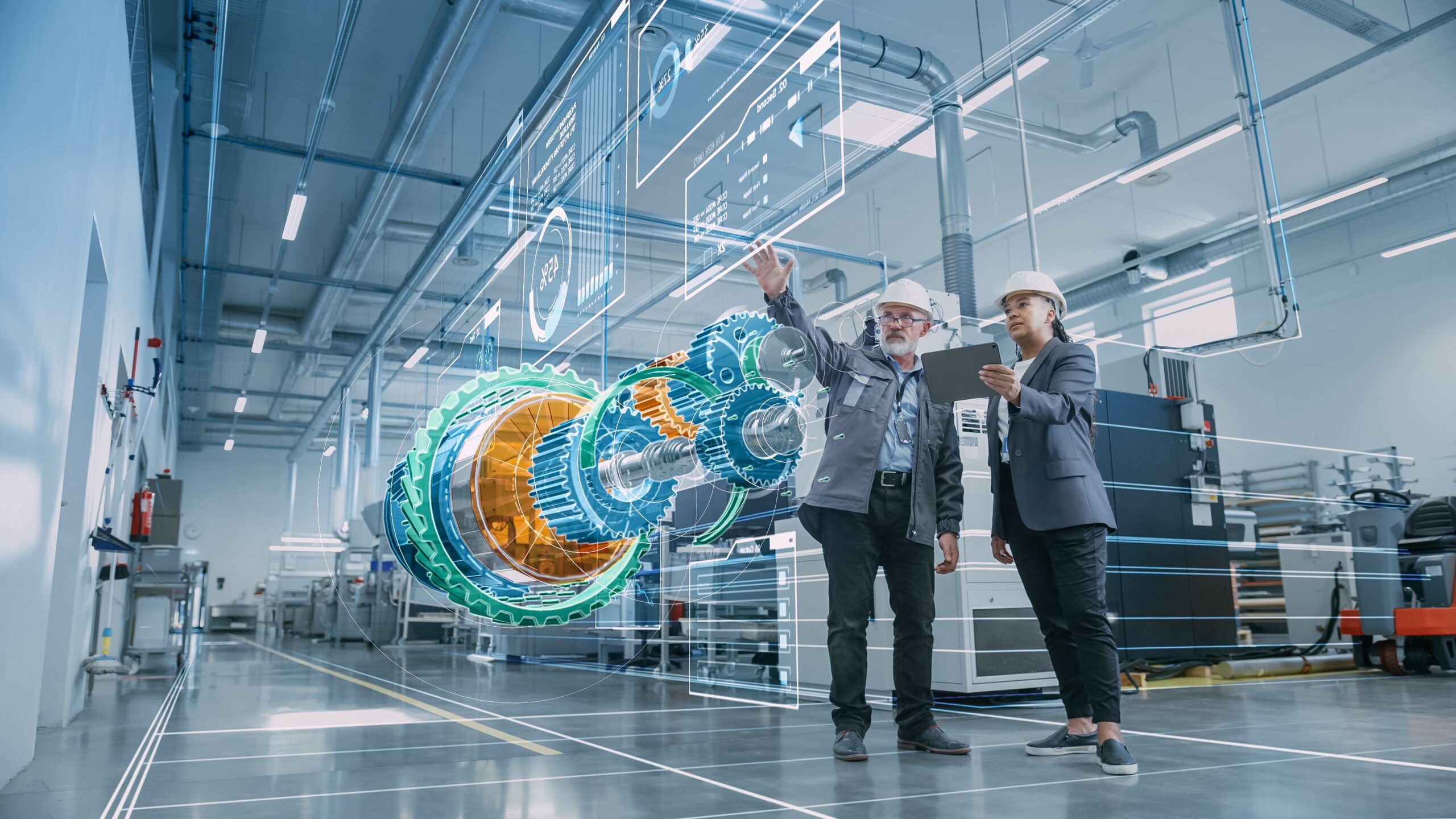
Digital twins are another area where AVEVA is setting new standards. The company treats them not as static models but as “living systems” that continuously interact with real-world data. “We’re shifting from static models to live operational systems that ingest real-time plant data, run physics and AI continuously, and write decisions back to control,” he explains. “This allows for semi-autonomous or even fully autonomous operations in some cases.” By combining physics-based models, machine learning and real-time data from AVEVA’s PI System, the twin can predict issues, issue early warnings and act as an advisor to human operators.
Across the Middle East — particularly in Saudi Arabia — AVEVA is aligning closely with national goals for industrial modernisation and sustainability. “In Saudi, we have a specific focus on infrastructure, water, energy and chemicals,” Salah says. “We’re also developing more capability within data centres, which are becoming a major priority.” He adds that the global rise of AI workloads has made energy efficiency a shared concern. “We see a lot of pressure worldwide to generate more power. The surge of AI is putting pressure on capacity, and we don’t have enough time to build new plants. That’s why industries are now focusing on optimising demand and improving efficiency within existing facilities. It’s a global shift, not just in Saudi Arabia.”
Localisation remains key to AVEVA’s regional approach. “We think of ourselves as the most global local company,” Salah says. “Partners enjoy working with us because when AVEVA and Schneider Electric come together, we provide customers with an open, software-defined platform. Our solutions are highly interoperable and offer a consistent, simplified user experience – with security and openness at the core.” AVEVA emphasises the importance of its partner ecosystem: “We have partners who resell our products, others who execute, and some who add their own value on top,” he says. “We provide them with hands-on training, free product trials, and co-development opportunities. When we talk to customers, two topics dominate every discussion – digitalisation and decarbonisation. Both depend on radical collaboration. No one can achieve them alone.”
The AVEVA-Schneider Electric alliance is well established. According to AVEVA’s own partner page, “Schneider Electric and AVEVA are working together to combine energy management and automation systems with industrial software. Our goal is to help you accelerate your digital transformation so that you can build a more prosperous future for your business, and a more sustainable future for all.”
One concrete outcome of the partnership is their joint innovation in data-centre liquid cooling: “Combining Schneider’s energy and automation expertise with AVEVA’s leadership in industrial software”, they enable operators to simulate and optimise liquid-cooled data centres where thermal load has become a critical bottleneck.
Another example: at a recently announced large-scale e-methanol plant project, Schneider Electric and AVEVA solutions formed the integrated technology stack.
The upcoming Schneider Electric Innovation Summit 2025 in Riyadh provides a backdrop for the next chapter. AVEVA is set to showcase its AI-driven industrial innovations as part of the event.
“We will be speaking about unlocking the power of ecosystems,” Salah says. “Platforms like AVEVA Connect allow organisations to share data, assets and operations securely across the entire lifecycle — from design and build to operate and maintain.” It’s a reminder that, in their view, collaboration is not optional: it’s essential.
As industries navigate an increasingly complex landscape, AVEVA’s message is one of readiness and resolve. “We already have the technology to solve today’s challenges,” Salah concludes. “This is the best time to collaborate, to use the technology we have, and to help industries thrive.”








Discussion about this post