

• About Us
  • Advertising
  • Digital Magazine
  • Supplements
  • Media Pack
  • Privacy Policy
  • Contact us
CXO Insight Middle East
  • News
  • Opinion
  • Business
    • Industries
      • Transport
      • Retail
      • Government
      • Real Estate
      • Education
      • Energy
      • Banking and Finance
    • Channel
  • Future
    • Tech
    • Gadgets
    • Science
    • Space
    • Sustainability
  • Events
    • Channel Awards
      • 2025
      • 2024
      • 2023
    • Channel Insights Summit 2025
    • Insight Innovation Summit
    • CXO50 Oman
    • CXO50
      • 2026
      • 2025
    • ICT Awards
      • Dubai 2025
      • Saudi Arabia
    • Cyber Strategists Summit
    • Cloud Connect 2025
    • All events
  • Digital Magazine
  • GITEX GLOBAL
No Result
View All Result
CXO Insight Middle East
  • News
  • Opinion
  • Business
    • Industries
      • Transport
      • Retail
      • Government
      • Real Estate
      • Education
      • Energy
      • Banking and Finance
    • Channel
  • Future
    • Tech
    • Gadgets
    • Science
    • Space
    • Sustainability
  • Events
    • Channel Awards
      • 2025
      • 2024
      • 2023
    • Channel Insights Summit 2025
    • Insight Innovation Summit
    • CXO50 Oman
    • CXO50
      • 2026
      • 2025
    • ICT Awards
      • Dubai 2025
      • Saudi Arabia
    • Cyber Strategists Summit
    • Cloud Connect 2025
    • All events
  • Digital Magazine
  • GITEX GLOBAL
No Result
View All Result
CXO Insight Middle East
No Result
View All Result

Human error fuels breaches as only half of professionals receive cybersecurity training, Kaspersky finds

by CXO Staff
December 5, 2025
in Future, News, Tech

A recent Kaspersky survey in the Middle East, Turkiye and Africa (META) region entitled “Cybersecurity in the workplace: Employee knowledge and behaviour”, announced during Black Hat MEA 2025 in Riyadh, KSA, found that just 50%of professionals received a training on digital threats

Human error fuels breaches as only half of professionals receive cybersecurity training, Kaspersky finds

A recent Kaspersky survey in the Middle East, Turkiye and Africa (META) region entitled “Cybersecurity in the workplace: Employee knowledge and behaviour”, announced during Black Hat MEA 2025 in Riyadh, KSA, found that just 50%of professionals received a training on digital threats. This knowledge gap is significant, especially given that the majority of cybersecurity breaches are attributed to human error. The findings underscore a need for IT departments to provide clear guidance and for organisations to implement structured, practical cybersecurity training that reaches employees at every level.

Many cyberattacks today are deliberately designed to bypass digital defences by exploiting human psychology. “Social engineering” schemes, like phishing emails, manipulate trust and urgency to trick employees into sharing sensitive information or initiating fraudulent transactions. Nearly half of surveyed professionals (45,5%) encountered scams disguised as messages from their organisation, colleagues or suppliers within the past year, while 16% suffered negative consequences after such deceptive communication. Other cybersecurity issues closely linked to the human factor include compromised passwords, the leakage of sensitive data, unpatched IT systems and applications, unlocked and unencrypted devices.

The issue of human-related cyberattacks can be addressed through appropriate education. 14% of respondents acknowledged they made IT-related mistakes due to a lack of cybersecurity knowledge. At the same time, training was named as the most effective means of raising cybersecurity awareness among non-IT employees: 62% of professionals chose it over other options such treat stories (23%) and references to legal responsibility (44%). These findings show that cybersecurity training is an essential layer of organisational defence.

When given the opportunity to choose specific training topics, respondents said they would choose ones dedicated to protecting confidential work data (43,5%); security of accounts and passwords (38%), websites and internet (36,5%), use of social networks and messengers (32%), mobile devices (31,5%), e-mails (29%); safe remote work (24%) and the use of neural network-based services such as chatbots (16,5%), while 25% would prefer to undergo all the above trainings, which highlights the broad demand for comprehensive cybersecurity education.
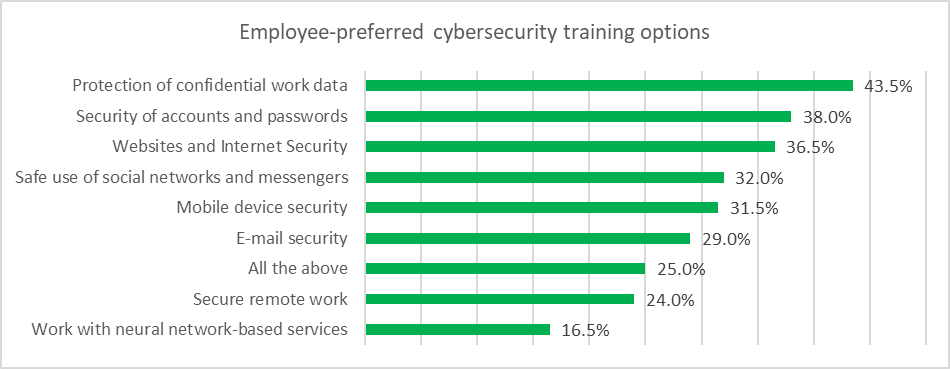
The data shows that employees are open to improving their cybersecurity skills. However, for this knowledge to become an integral part of their daily IT routines, training needs to be well-structured, tailored to the role and existing IT skills of each employee, regularly updated, as well as gamified and practical. This approach enhances engagement and knowledge retention. When organisations invest in such education, they are not just meeting a requirement but also fostering a “security-first” mindset among workforces. This turns employees from a potential point of weakness into a distributed network of vigilant guards, capable of making smart security decisions instinctively.

“Cybersecurity cannot be siloed within the IT department. From the C-suite to the intern, a shared understanding of digital risks is essential. Building a resilient organisation requires empowering every employee with the knowledge to spot a scam, avoid costly mistakes, and become a true guardian of company data,” says Mohamad Hashem, General Manager for Saudi Arabia and Bahrain at Kaspersky.

To strengthen their defences organisations should consider the following:

  • Implement robust monitoring and cybersecurity solutions, for example from the Kaspersky Next product line.
  • Introduce employee education and cybersecurity trainings, such as Kaspersky Automated Security Awareness Platform, developed to help IT and HR departments with delivering practical cybersecurity skills to employees.
  • Implement security policies for employees, from password and software installation to network segmentation.
  • Foster a culture of security: encourage employees to report suspicious activity, reward proactive security behaviours to reinforce good habits.

*The survey was conducted by Toluna research agency at the request of Kaspersky in 2025. The study sample included 2800 online interviews with employees and business owners using computers for work in seven countries: Türkiye, South Africa, Kenya, Pakistan, Egypt, Saudi Arabia, and the UAE.

Tags: cybersecurity trainingKaspersky
ShareTweet

Related Posts

5 ways 2026 will define AI for organisations across EMEA
Future

5 ways 2026 will define AI for organisations across EMEA

February 4, 2026

As we approach 2026, artificial intelligence in EMEA is entering a new era defined not by experimentation, but by execution....

IFS, Albatechnics to strengthen digital MRO capabilities
Business

IFS, Albatechnics to strengthen digital MRO capabilities

February 4, 2026

IFS announced a new collaboration with Albatechnics, an Italy‑based aviation maintenance and engineering provider. The announcement is being made live...

Discussion about this post

Latest Issue

5 ways 2026 will define AI for organisations across EMEA

5 ways 2026 will define AI for organisations across EMEA

February 4, 2026
IFS, Albatechnics to strengthen digital MRO capabilities

IFS, Albatechnics to strengthen digital MRO capabilities

February 4, 2026
Nemetschek Group, Ingram Micro to accelerate digital transformation across MENA region

Nemetschek Group, Ingram Micro to accelerate digital transformation across MENA region

February 4, 2026

The most trusted source of strategic intelligence for IT decision makers in the Middle East.

About

  • About Us
  • Advertising
  • Digital Magazine
  • Supplements
  • Media Pack
  • Contact Us

Policies

  • Privacy Policy
© 2025 – CXO Insight Middle East. All Rights Reserved.
Facebook-f X-twitter Linkedin
Separated they live in Bookmarksgrove right at the coast of the Semantics, a large language ocean. A small river named Duden.

About

  • About Us
  • Site Map
  • Contact Us
  • Career

Policies

  • Help Center
  • Privacy Policy
  • Cookie Setting
  • Term Of Use

Join Our Newsletter

© 2024 – CXO Insight Middle East. All Rights Reserved.

Facebook-f Twitter Youtube Instagram

Welcome Back!

Login to your account below

Forgotten Password?

Retrieve your password

Please enter your username or email address to reset your password.

Log In
Join our mailing list
Sign up here to get the latest news, updates and special offers delivered directly to your inbox.
No Result
View All Result
  • News
  • Opinions
  • Business
    • Industries
      • Transport
      • Retail
      • Government
      • Real Estate
      • Education
      • Energy
      • Banking and Finance
  • Channel
  • Future
    • Tech
    • Gadgets
    • Science
    • Space
    • Sustainability
  • Events
    • Channel Awards
      • 2025
      • 2024
      • 2023
    • Channel Insights Summit 2025
    • Insight Innovation Summit
    • CX50 Oman
    • CXO50
      • 2026
      • 2025
    • ICT Awards
      • Dubai
      • Saudi Arabia
    • Cyber Strategists Summit
    • Cloud Connect 2025
    • All events
  • Videos
  • GITEX GLOBAL
  • Digital Magazine

© 2025 - CXO Insight Middle East. All Rights Reserved.