
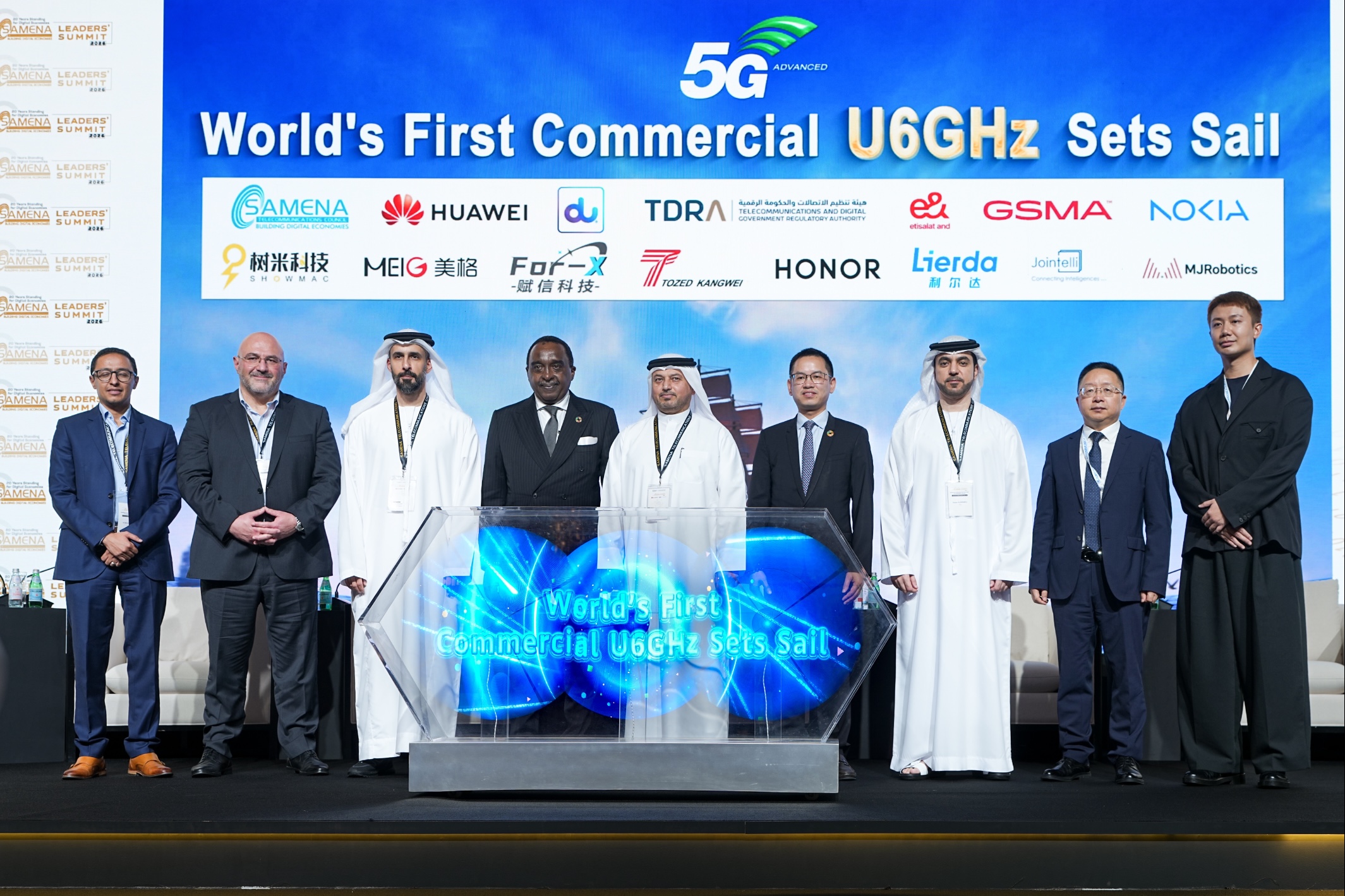
The SAMENA Council Leaders’ Summit 2026 marked the launch of a commercial Upper 6GHz (U6GHz) ecosystem, bringing together regulators, operators, device manufacturers, and technology vendors under a shared industry commitment.
The development reflects a shift towards deployment of new spectrum to support rising data demand and AI-driven network traffic, while positioning the UAE among early adopters shaping next-generation connectivity.
The U6GHz initiative was advanced during the 5G-Advanced & AI Applications for Resilient Economy Forum, held as part of the summit, where industry stakeholders, including chipmakers and device manufacturers, participated in the first step towards commercialisation. The move supports the continued evolution of 5G-Advanced and early preparation for 6G.
During the joint commercialisation initiation ceremony, representatives from the Telecommunications and Digital Government Regulatory Authority, the SAMENA Telecommunications Council, Huawei, du, e&, GSMA, Nokia, HONOR, and Tozed confirmed their participation in the ecosystem.
A separate session on 6GHz policy, technology, and deployment alignment was also held, with GSMA as a policy partner and TDRA chairing discussions. The session addressed the need to balance allocation of the upper 6GHz band to support future mobile technologies while ensuring coexistence with existing services.
U6GHz refers to the 6425–7125MHz spectrum range, identified by 3GPP as Band n104. With 700MHz of contiguous bandwidth, it is designed to support both wide-area coverage and high-capacity performance as network demands increase.
The growing use of AI systems across industries is driving higher data volumes, increasing pressure on networks to deliver balanced uplink and downlink performance with low latency and reliability.
Estimates from SAMENA Council technology members indicate that U6GHz could support peak speeds of up to 10Gbps downlink and 1Gbps uplink under 5G-Advanced. The band is also expected to support the transition from 5G-Advanced to 6G, in line with a roadmap issued by TDRA-UAE. In the UAE, the spectrum is expected to support infrastructure development across sectors including finance, healthcare, and manufacturing.
The U6GHz ecosystem is now moving from technical validation to early-stage commercial deployment, with vendors demonstrating compatible infrastructure and ecosystem players progressing development.
At MWC26, Huawei introduced U6GHz-compatible products designed to deliver coverage comparable to C-band and peak rates of 10Gbps. During the event, GSMA, alongside Huawei, Qualcomm, Tozed, Meig, and others, indicated readiness for deployment, while operators including Vodafone, China Mobile, and Brazil TIM completed field testing.
Bocar BA, CEO, SAMENA Council, said, “With this U6GHz ecosystem launch, the UAE has moved ahead of many markets in transitioning from trials to commercial rollouts, and it is a privilege that this development has taken place during the Leaders’ Summit 2026, an industry leadership meeting held during these challenging times in the regional context, to foster dialogue, build support for the ecosystem, and to signal continuity in efforts toward collaboration and development.”
GSMA stated that the U6GHz ecosystem is ready to support commercial deployment and will play a role in enabling 10Gbps connectivity while serving as an initial spectrum for future 6G networks. The organisation noted that the Middle East is positioned to benefit from early adoption during the 5G-Advanced phase.
In 2025, e& UAE, working with partners including Huawei, completed U6GHz field tests achieving a 10Gbps user experience. The Leaders’ Summit 2026 ceremony marks the transition towards commercial deployment of U6GHz services.
Deployment is expected to expand across major cities and economic zones, supporting applications in areas such as smart cities, industrial systems, healthcare, and tourism. Potential use cases include remote medical diagnostics, traffic management, and immersive digital services.
The rollout is also expected to involve collaboration with global technology partners on development and standardisation, alongside knowledge-sharing on deployment.
By 2028, U6GHz networks are expected to cover more than 80% of the UAE population, supporting long-term digital infrastructure development and preparation for 6G.








Discussion about this post