

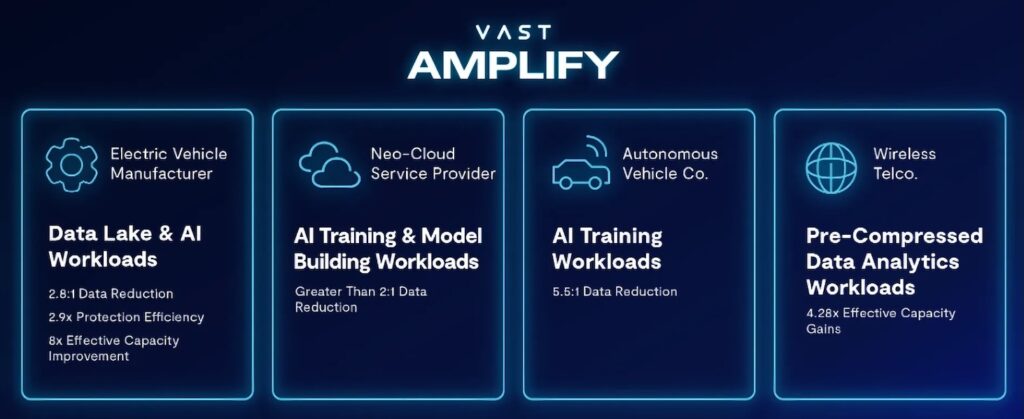
VAST Data announced a new capacity optimisation programme – VAST Amplify. This new customer engagement is designed to help enterprises and service providers increase effective flash capacity using the SSDs they already own. As storage lead times and allocation windows tighten, VAST Amplify provides a structured path for customers to identify underutilised flash, rapidly qualify and repurpose existing hardware, and consolidate capacity into the VAST AI Operating System’s unified Disaggregated Shared Everything (DASE) architecture, delivering up to 6× or more effective capacity, depending on workload characteristics and existing environment.
Across the industry, capacity planning has become increasingly constrained by supply availability, and these SSD shortages are exposing architectural inefficiencies across modern data platforms – including replication-heavy protection models, fragmented data stacks, and performance approaches that depend on over-provisioned flash. VAST Amplify addresses these constraints by helping organisations reclaim stranded SSD capacity and convert installed flash into a unified, globally accessible pool – increasing usable capacity and sustaining AI and analytics growth even as flash becomes scarcer and more expensive, without waiting for new procurement cycles.
“Storage scarcity is forcing organisations into impossible trade-offs – delay programmes, ration capacity, or accept whatever allocation they can get,” said Phil Manez, Vice President, GTM Execution at VAST Data. “With VAST Amplify, we’re giving customers a practical alternative: reclaim the flash you already have, consolidate it into a modern architecture, and materially increase the usable capacity and performance you can deliver to the business.”
As organisations scale AI from training into higher-volume inference, emerging approaches that persist and reuse inference state – including key-value (KV) cache – are beginning to add additional demand for fast storage, further increasing the importance of maximising effective capacity from existing flash.
VAST Amplify is designed to meet customers where they are – operationally and technically – while aligning each engagement phase to measurable efficiency gains at scale, including:
- Estate intelligence – VAST analyses the environment to identify underutilised SSD capacity, fragmentation across silos, and architecture-driven waste that suppresses effective capacity.
- Rapid platform qualification – VAST accelerates qualification of existing server and SSD configurations so customers can reuse installed flash with a clear path to production, reducing dependency on new allocation windows and long lead times.
- Capacity reclamation & pooling – VAST helps customers repurpose and consolidate existing SSD investments into a unified VAST environment, so capacity is globally accessible, dynamically allocated, and no longer constrained by server boundaries or legacy designs.
- Platform-level durability – Data protection is handled once at the platform layer using highly efficient erasure coding rather than replication-heavy approaches, increasing usable capacity while maintaining resilience at scale.
- Global similarity-based data reduction – Continuous, global reduction is applied across the namespace—eliminating redundant patterns wherever they occur (not just within individual volumes), enabling materially higher effective capacity on a fixed flash footprint.
- SCM-optimised write architecture – Random and bursty writes are absorbed in Storage Class Memory (SCM) and written to SSDs efficiently in larger, sequential segments—reducing write amplification, improving endurance, and sustaining low-latency performance without requiring overprovisioned flash.
- More usable capacity per SSD – By combining platform-level durability, global data reduction, and SCM-based write efficiency, VAST Amplify can deliver up to 6× or more effective capacity from existing SSD investments, depending on workload and environment.
By consolidating flash into a unified VAST environment, customers can reduce the friction of workload-by-workload capacity planning and instead support a broader range of use cases from a shared pool – including data-intensive analytics, real-time pipelines, modern databases, and AI infrastructure needs such as high-performance repositories for model data and emerging inference-era requirements.
Experience VAST’s industry-leading approach to AI and data infrastructure at VAST Forward, their inaugural user conference, February 24–26, 2026 in Salt Lake City, Utah. Engage with VAST leadership, customers, and partners through deep technical sessions, hands-on labs, and certification programmes. Register here to join.








Discussion about this post