
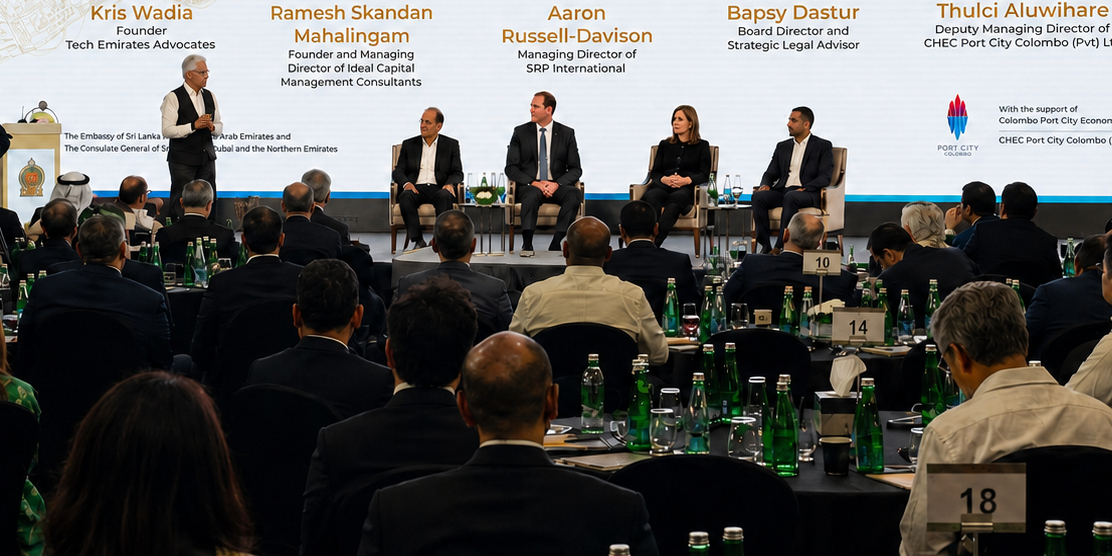
Sri Lanka’s evolving role in regional trade, investment and business expansion took centre stage in Dubai as senior business leaders, investors and policymakers gathered for Globalisation and the Sri Lankan Opportunity – From Recovery to Relevance: Sri Lanka’s Moment in the Evolving Global and Regional Economy.
Held at the Ritz-Carlton DIFC, the event brought together around 200 business leaders, investors and policymakers from across the UAE and Sri Lanka. Organised by the Embassy of Sri Lanka in the UAE, the Consulate General of Sri Lanka in Dubai and the Northern Emirates, the Colombo Port City Economic Commission and CHEC Port City Colombo, the event focused on how Sri Lanka is seeking to capitalise on growing economic ties between the Gulf and South Asia.
Opening the forum, H.E. Prof. Arusha Cooray, Ambassador of Sri Lanka to the United Arab Emirates, highlighted the longstanding relationship between the UAE and Sri Lanka. He outlined Sri Lanka’s ambition to deepen that relationship further by positioning itself as a gateway for UAE businesses seeking to expand their presence across South Asia.
The keynote address was delivered by Ghanim Al Falasi, CEO of Falak Tayyeb Platinum and Senior Vice President/Director General’s Office for Dubai Silicon Oasis (DSO), who drew on his experience across the UAE’s innovation and technology ecosystem to examine the opportunities emerging across South Asia. He highlighted the natural synergies between Dubai and Colombo, describing Dubai as a global hub for capital, logistics and international business, and Colombo as a strategic gateway to South Asia, with both cities serving complementary roles within the regional economy.
The discussions throughout the event focused on investment, governance and regional connectivity, with Port City Colombo highlighted as a project designed to attract international investment through a dedicated regulatory framework and investor-friendly environment.
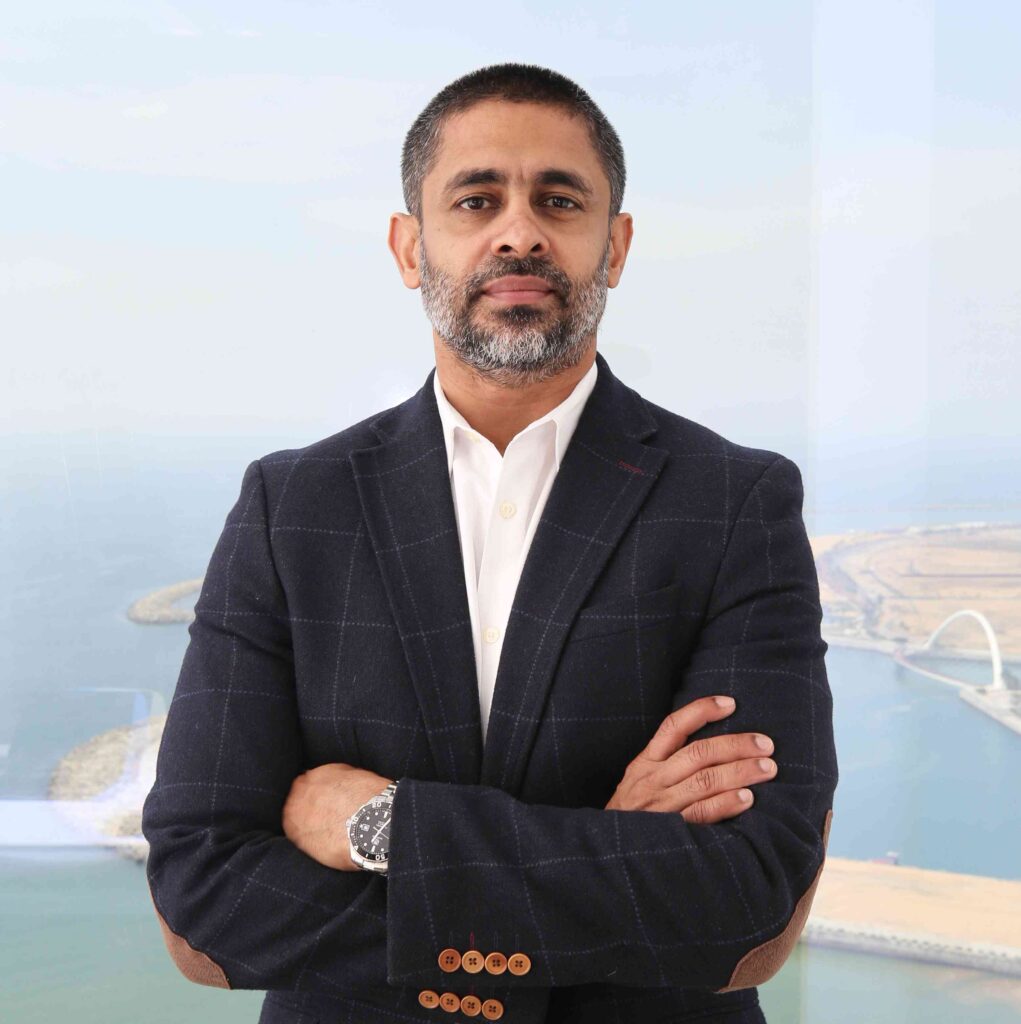
Speaking to CXO Insight Middle East on the sidelines of the event, Thulci Aluwihare, Deputy Managing Director, CHEC Port City Colombo offered further insight into how the project is evolving, and why technology is emerging as one of the sectors expected to play a central role in its long-term ambitions.
“This project was initially conceived as a pure real estate development project,” he said. “It had a great location and waterfront access. But as we developed it with the Government of Sri Lanka, we felt the project could be much more.”
He said that shift in thinking was driven in part by the structure of Sri Lanka’s economy. With services accounting for close to 60 percent of GDP, the opportunity was not simply to develop physical infrastructure, but to create an ecosystem capable of attracting businesses operating in technology, professional services and other high-value sectors.
That prompted the team to look beyond traditional industrial zones and examine how leading business ecosystems had been built elsewhere.
“We said we don’t have a services-oriented special economic zone,” he explained. “So we looked around and benchmarked a number of other zones to see what we could learn from them, studying how successful ecosystems had been structured. DIFC quickly emerged as a key source of inspiration because it demonstrated how a well-designed ecosystem could evolve into a globally recognised business and financial hub.”
Port City Colombo subsequently consulted former DIFC executives and worked closely with former DFSA officials as the project evolved, according to Aluwihare. Those discussions influenced aspects of the project’s positioning, legal and regulatory framework, and investor facilitation model. “Our aspiration is to build for South Asia what DIFC has become for the Gulf. The technology sector is central to that vision. It is already one of Sri Lanka’s strongest industries, and today around 50 percent of the businesses operating within Port City Colombo are technology-related,” he said.
Rather than attempting to compete directly with larger technology markets, Port City Colombo is positioning itself as a complementary platform for businesses looking to establish regional operations, strengthen resilience or expand research and development capabilities.
“What we are trying to appeal to technology companies is that Colombo Port City can serve as a business continuity hub, a disaster recovery location, or an R&D destination with opportunities higher up the value chain in terms of technology offerings,” Aluwihare said.
Looking ahead, Aluwihare believes the next phase of the project’s development will involve building stronger relationships with innovation ecosystems across the Gulf and positioning Port City Colombo as a bridge between Gulf-based businesses and South Asia’s growth markets.
“India is poised for significant growth over the next decade. However, entering and doing business in the country can sometimes be complex,” he said. “One of the roles Port City Colombo can play is helping technology companies establish a presence closer to South Asia’s growth markets. For example, it can serve as a satellite city for businesses assessing opportunities across the region. If you are looking to access that growth, this can be a platform from which to do so.”








Discussion about this post