
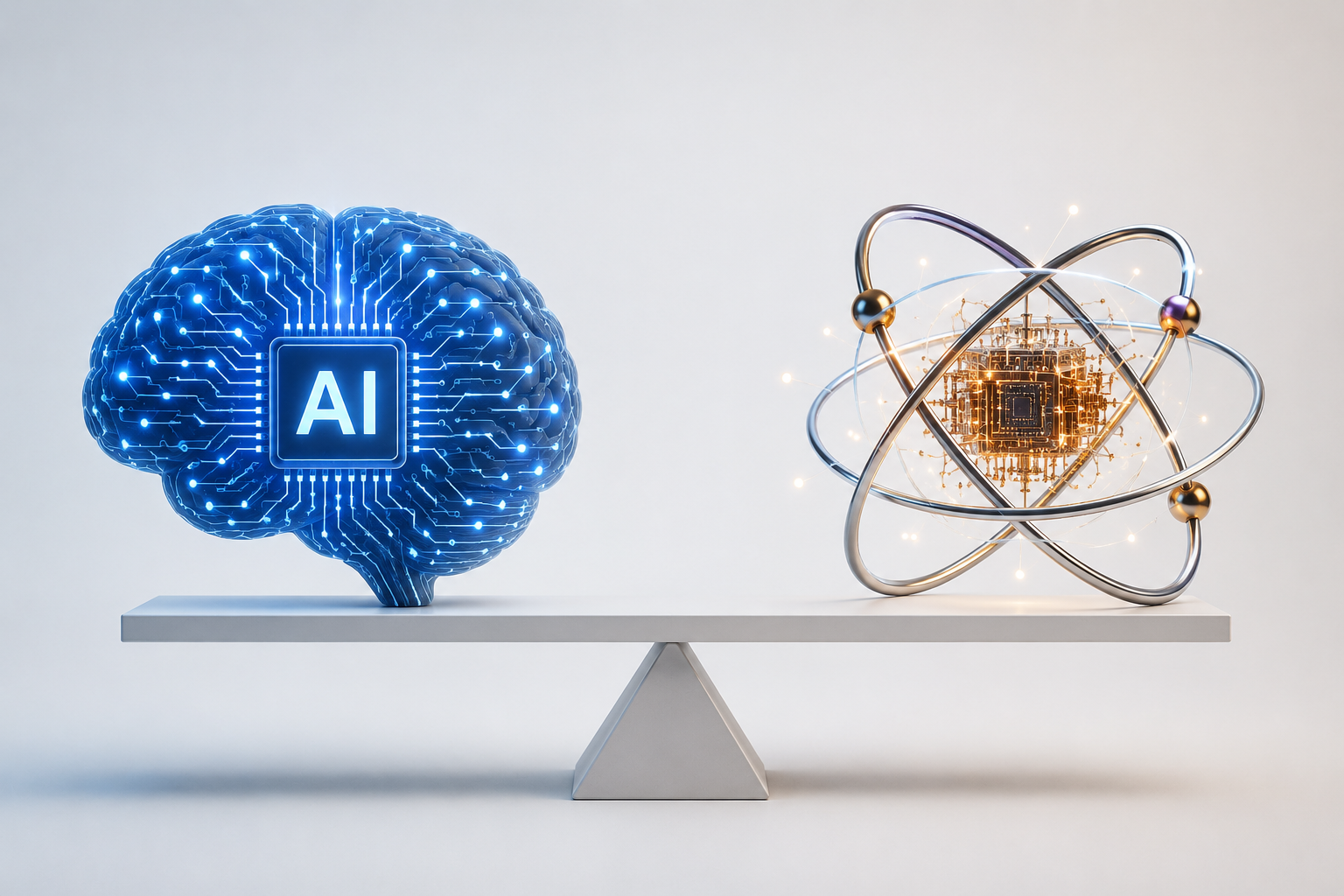
Across the UAE, rapid advances in artificial intelligence and digital infrastructure are transforming how public services, businesses, and individuals operate. As this digital momentum continues, organisations must confront two cybersecurity challenges that define different ends of the risk spectrum, one immediate and visible, the other strategic and approaching.
Artificial intelligence agents are already being deployed by cybercriminals to automate attacks with greater efficiency and scale. At the same time, quantum computing presents a looming threat to the cryptographic foundations protecting today’s digital systems. Both technologies need attention now more than ever as public and private sectors in the UAE invest in endpoint devices like commercial PCs and printers that will remain in service well into the next decade.

AI Agents: Scaling attacks with automation
Cybercriminals are no longer relying solely on human effort for reconnaissance or vulnerability scanning. In 2026, AI agents are expected to take over many preparatory steps in the attack lifecycle – researching targets, identifying weak points, and even crafting social engineering campaigns. This evolution marks a shift from manual intrusion to scalable, AI-driven attack models.
These agents are being used to assist with complex tasks like discovering unpatched vulnerabilities and gaining access to enterprise infrastructure. The fast adoption of hybrid work models and distributed teams makes these attacks more difficult to detect and contain, particularly as endpoints become more mobile and varied.
Traditional security tools may fail to intercept such dynamic, adaptive threats. Organisations must pivot toward containment and isolation strategies that assume breaches will happen and focus on minimising damage. PCs now play a critical role in this model, through built-in self-healing firmware, application isolation, and endpoint threat telemetry that ensures quick response without disruption to productivity.
Quantum computing: A long-term risk with strategic impact
While AI enables attackers to act faster, quantum computing introduces a different risk: the ability to break encryption that secures data today. The global cybersecurity community now sees quantum decryption as a realistic threat within the decade, prompting governments and critical sectors to begin migrating to quantum-resistant algorithms.
This has immediate implications for the UAE’s IT and procurement leaders. Many of the endpoint devices and IT systems deployed in 2026, particularly in government, healthcare, finance, and infrastructure, will still be active when quantum computing reaches cryptographically relevant capability. Devices with long refresh cycles, such as commercial PCs and office-class printers, must be evaluated not only for today’s risks but for their ability to withstand tomorrow’s.
Quantum resilience is no longer optional for forward-looking organisations. Devices must be designed with cryptographic agility in mind, ensuring that algorithms can be upgraded or replaced in line with evolving global standards. Procurement decisions made now will determine whether systems deployed in the late 2020s remain trustworthy through the 2030s.
A security strategy built for two timelines
Tackling both of these risks requires a dual strategy. In the near term, organisations must strengthen defense mechanisms against AI-driven attacks by upgrading endpoint security, reducing reliance on legacy authentication models, and adopting zero trust principles that limit lateral movement after a breach.
Simultaneously, longer-term security planning must prioritise quantum resilience. That means working with technology partners that are already embedding next-generation cryptography into their hardware and firmware layers and selecting device platforms with security controllers capable of resisting both current and future decryption techniques.
This approach is not just about managing risk. It reflects a broader shift toward securing national digital infrastructure, especially in regions like the Middle East where AI and automation strategies are critical to long-term economic competitiveness.
Conclusion
The convergence of AI and quantum is reshaping cybersecurity from two directions – one pressing and fast-evolving, the other distant but unavoidable. One demands agility. The other requires foresight.
As the UAE moves deeper into its digital transformation journey, organisations that build both short-term resilience and long-term protection into their endpoint strategies will be best positioned to protect their operations, data, and reputations in an increasingly complex digital landscape.








Discussion about this post