

Saudi Arabia has invested heavily in the digital groundwork for Vision 2030. The UN ranked the Kingdom sixth globally in its 2024 digital government ranking. AI adoption is also growing across businesses, particularly in information technology, finance, insurance and public sector.

But using AI doesn’t automatically mean getting results from it. Adding new technology to existing ways of working can only take organisations so far. In some cases, it can create more problems than it solves.
Most business processes were designed before AI existed. They rely on approval chains, handoffs between teams and people managing exceptions because that was how work had to be coordinated. Add AI to one step and that step gets faster. But the surrounding steps remain unchanged. Systems still struggle to communicate, and productivity gains can disappear. In that sense, every process is potentially a legacy process.
For Saudi organisations working towards Vision 2030, the challenge is not simply adopting AI. It is changing how work gets done. Here are five principles leaders should consider.
1. Ask whether a step should exist before asking how to automate it
Many approvals and handoffs exist because older systems couldn’t be trusted or connected. They slow things down without adding meaningful judgment. Automating them just creates a faster version of an unnecessary step.
Consider a government service requiring citizens to submit the same information to several departments. AI could help each department process applications faster. But wouldn’t it make more sense to redesign the service so that information only needs to be submitted once? Several governments around the world are already rethinking how citizen services are delivered by reducing duplicate processes and enabling information to be shared seamlessly across departments. Rather than accelerating outdated workflows, the focus is increasingly on redesigning services around citizen needs, creating more efficient, transparent, and user-friendly experiences.
The bigger opportunity isn’t making every existing step faster. It’s questioning whether those steps are needed at all.
2. Design around the outcome instead of adding AI on top
McKinsey’s 2026 global AI survey found that nearly three in four high-performing organisations had fundamentally redesigned their workflows around AI, compared with just one in four other organisations.
Take a bank processing a loan application. AI might review documents faster, but if applications still move between disconnected systems and wait for manual approvals, customers may see little difference. Leading financial institutions are increasingly focusing on end-to-end process orchestration to improve visibility, reduce operational complexity and deliver a more consistent customer experience.
The challenge is coordinating the entire process across systems, AI agents and people, with clear accountability for the outcome.
We encountered this in our own quote-to-cash process, spanning initial sales opportunities through subscription activation and renewals. It involved five departments, six systems and 20 to 80 manual handoffs per contract, with no single process owner. By redesigning it, we reduced manual touchpoints to two or three and shortened the cycle from 115 to 80 days.
The lesson is simple: technology cannot fix a process that nobody owns from beginning to end.
3. Start with a broken process, not an AI agent
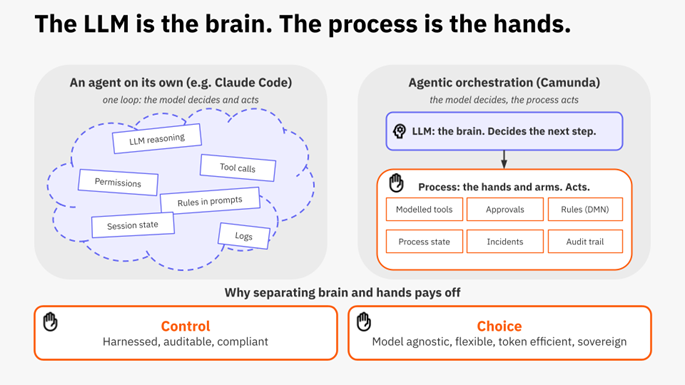
Not every problem needs an AI agent, which is software that can take actions instead of just making suggestions. Gartner expects more than 40% of agentic AI projects to be cancelled by the end of 2027, mainly due to rising costs, unclear value, or weak risk controls.
The temptation is to use AI wherever possible. But deterministic automation is often enough for predictable tasks that follow clear rules, such as verifying whether an application meets certain requirements or processing an approved payment. AI is more useful when information varies or when some judgment is required, such as interpreting different documents or handling unusual customer requests.
The distinction matters because adding an agent to every step can introduce unnecessary costs and complexity. An organisation also needs to know what happens when an agent cannot complete a task, when its output needs to be checked or when it must hand work back to a person.
Choose a process with a clear problem, like a slow approval or onboarding. Set a target, show that it works, and only then expand.
4. Give AI autonomy without losing accountability
Redesigning processes doesn’t mean removing people. It means involving them where their judgement matters: approving critical decisions, handling exceptions and checking changes before implementation.
This is particularly important in banking, government and energy, where decisions must be auditable and actions traceable.
As AI moves from recommendations to actions, organisations need clear answers: What can AI do independently? Can its actions be explained? Who is responsible when something goes wrong?
For Saudi organisations, this also means developing employees’ ability to supervise AI and ensuring clear ownership of processes spanning multiple departments.
The goal isn’t to automate everything. It’s finding the right balance between speed, judgement and control.
5. Measure the process, not the AI
Track what matters to the business: approval times, transaction costs, error rates and customer outcomes. Don’t simply count how many employees use an AI tool.
Faster document reviews mean little if customers still wait days for decisions. Similarly, automating individual government tasks won’t necessarily improve services if the overall journey remains complicated.
Organisations must measure the entire process, identify where delays occur and understand whether improvements in one area create problems elsewhere.
They must also keep reviewing processes as AI capabilities evolve. Transformation cannot be a one-time exercise when technology and business requirements continue changing.
The takeaway
Vision 2030 presents an opportunity to build more efficient, responsive and competitive industries and public services.
But organisations risk investing in increasingly capable technology without changing the systems, responsibilities and handoffs that determine its value.
With 2030 approaching, leaders should ask: if we were designing this process today, knowing what AI can do, would we build it the way it runs now?
For many processes, the answer will be no. Organisations that act on that realisation will set the pace for the rest.









Discussion about this post