

The telecommunications sector has always been defined by its ability to adapt to new technologies. From fixed-line networks to mobile connectivity and now to the era of 5G, operators have consistently evolved to keep pace with demand. Today, however, the industry faces an even more profound transformation with the rise of generative artificial intelligence. Unlike earlier applications of AI, which focused largely on automation and predictive analytics, generative AI has the potential to reshape customer engagement, network operations, product innovation, and the very business models that telecoms depend upon.
This transformation is arriving at a time when global operators are under pressure. In mature markets, revenue growth has stagnated, margins are tightening, and competition from digital platforms continues to intensify. Market capitalisation figures tell the story, since 2018, telecom valuations have grown at a fraction of the pace of digital-first companies. At the same time, customers expect more personalied, frictionless interactions, regulators demand greater resilience, and cyber threats are escalating. Against this backdrop, generative AI is not a luxury or an experiment, but an imperative.

The GCC opportunity
The GCC is in a unique position. Unlike many established markets, operators in this region are less burdened by legacy infrastructure and are supported by ambitious national visions that prioritise technological leadership. This creates fertile conditions for leapfrogging incremental change and embracing transformation at scale. Across the region, exciting pilots and proof-of-concepts are already under way, ranging from AI-powered chat assistants to autonomous telecom retail stores. According to a Strategy& Middle East report, the telecom operators could generate up to $5.9 in ebitda (Earnings Before Interest, Taxes, Depreciation, and Amortisation) for every $1 invested in an AI-powered, data-fueled marketing personalisation engine, over five years.
The challenge is no longer one of innovation but of execution. The real differentiator over the next decade will be the ability to take promising pilots and expand them into platforms that touch every aspect of the business. In this context, speed matters as much as strategy. Breakthrough scale will separate the leaders from the laggards, and those who can master speed to scale will be tomorrow’s winners.
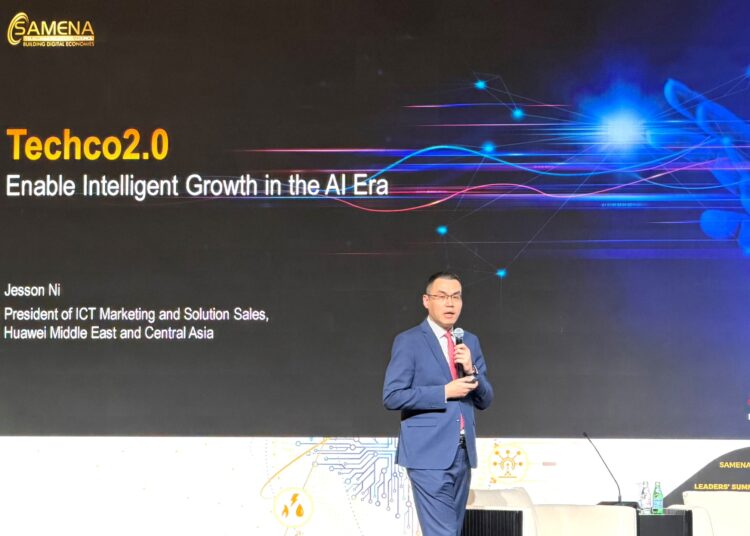
From telco to tech-co
The industry’s evolution is increasingly described in terms of the shift from telcos to techcos. This is more than a rebranding exercise. It reflects the reality that tomorrow’s leading operators will not only provide connectivity but also deliver highly automated, AI-driven experiences that extend well beyond traditional services. Generative AI accelerates this transition. In network management, it enables predictive maintenance and real-time anomaly detection that can pre-empt outages and cyber incidents. In customer service, it powers intelligent assistants capable of holding empathetic conversations and resolving issues in seconds rather than hours. In marketing and product design, it allows operators to create dynamic, hyper-personalised offerings that reflect customer behavior in real time.
Personalisation as a growth engine
Personalisation may prove to be one of the most powerful applications. Telecoms have vast amounts of customer and operational data – much of which has historically been underutilised. Generative AI makes it possible to unlock this value, offering plans, services, and experiences that feel tailor-made to each individual. Imagine a service model where a customer’s roaming package, entertainment bundle, or home connectivity upgrade is recommended instantly and contextually, based on both historical behavior and real-time context. This is the level of relevance customers now expect, and those who can deliver it consistently will build loyalty and revenue in equal measure.
The importance of ecosystems
Scaling such capabilities requires more than investment in technology. It calls for a commitment to human-centred design so that AI systems are transparent, trustworthy, and empathetic. It also demands strong ecosystems. Telecoms cannot pursue this journey alone. Partnerships with hyperscalers, technology vendors, governments, and startups are essential to deliver the platforms and capabilities needed to scale. Collaboration across the value chain is not optional but fundamental to success.
A vision for the future
For GCC countries, this is not just an industry opportunity but a national one. The region has long aspired to lead in global digital transformation, and generative AI offers the chance to achieve it. By embracing speed at scale, operators here can redefine customer and citizen experiences, support economic diversification, and set new global benchmarks. The decisions made in the next few years will shape not only regional competitiveness but also the role of telecoms in building smarter, more connected societies.
Generative AI has moved beyond pilots and proofs of concept. Tomorrow’s winners will be those who can embed it across their organisations, scale it rapidly, and balance automation with empathy and trust. Telecoms that embrace this path will thrive in the age of generative AI, while those who hesitate risk being left behind. Breakthrough scale will define the future, and the GCC has every opportunity to lead the way.








Discussion about this post