

Economic growth, public health and national resilience increasingly depend on something that often attracts little public attention: the uninterrupted movement of critical goods. As geopolitical tensions, shifting trade routes, and climate-related disruptions reshape global commerce, supply chains have evolved into strategic infrastructure, making resilience less about moving goods efficiently and more about maintaining real-time visibility across increasingly complex networks.
The UAE’s National Programme to Strengthen Supply Chain Resilience reflects that evolving reality. Approved by the UAE Cabinet in April 2026, the initiative focuses on strengthening food, pharmaceutical, and industrial supply chains against future disruption, recognising that national resilience depends as much on trusted digital infrastructure as it does on ports, roads, and logistics networks.
However, long before the programme was introduced, elements of the capability it calls for were already operating at national scale. Among them is Tatmeen, the UAE’s national pharmaceutical track-and-trace platform, developed in partnership with EVOTEQ through its traqpharma platform. It connects manufacturers, distributors, wholesalers, pharmacies, and hospitals through a single digital ecosystem, the platform has given regulators end-to-end visibility across the country’s pharmaceutical supply chain while continuing to operate through periods of exceptional disruption.
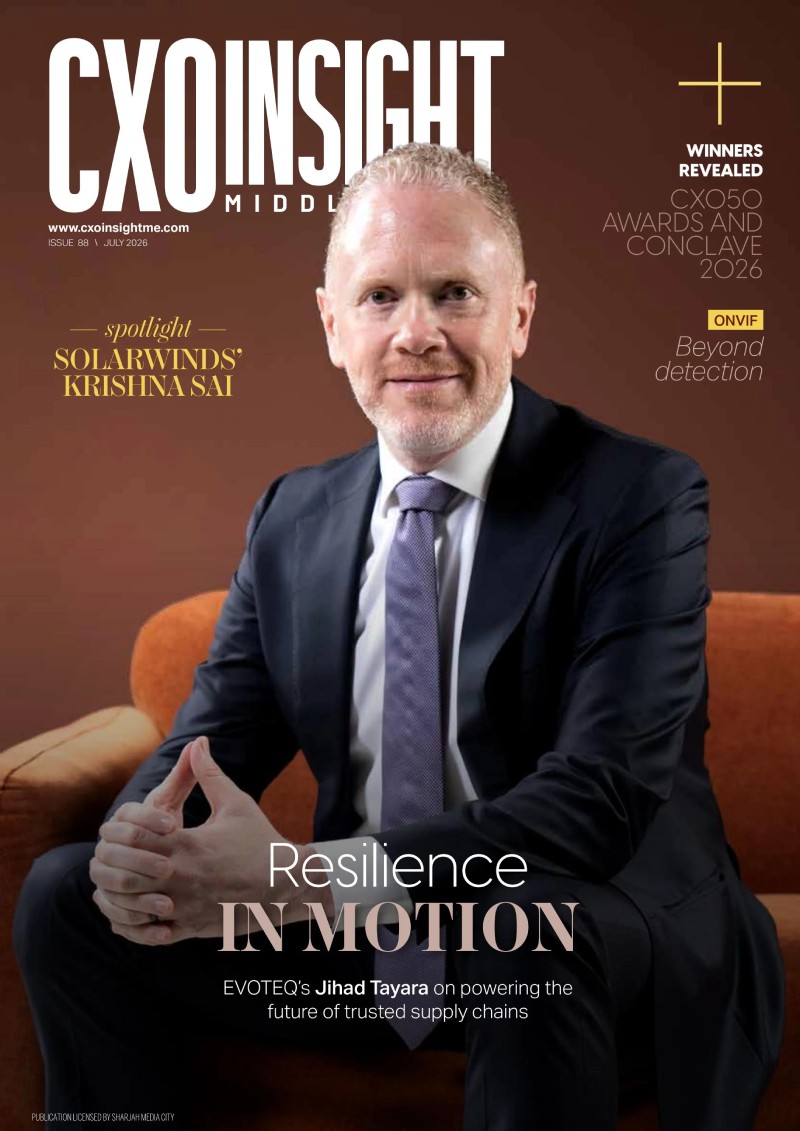
The launch of the national programme reflects the growing recognition of supply chain resilience as a national strategic priority. Jihad Tayara, CEO of EVOTEQ, sees the initiative as an important milestone in the country’s evolving approach to safeguarding the movement of critical goods.
“The UAE looked at what national supply chains needed to withstand disruption and reached the same conclusion we did years ago: traceability is not optional, it is the foundation,” he said. “The mandate is to secure food, medical, and industrial goods at a national level. Not optimise. Secure. Those are very different objectives, and they demand very different responses.”
That alignment between policy and operational capability is what makes the programme distinctive. Rather than creating a new direction, it formalises an infrastructure that had already been tested under real operating conditions, including the COVID-19 pandemic, the Red Sea shipping crisis and wider geopolitical pressures affecting global trade.
“The mandate has caught up with the infrastructure,” said Tayara. “We have been building this for years. The traqpharma platform powers Tatmeen, the UAE’s national pharmaceutical track-and-trace system, and it has remained live and operational through every major disruption this region has experienced. The architecture is proven. The standards are established. The proof exists at scale.”
Building the right foundations
Technology alone rarely determines the success of national transformation programmes. Before any national platform can succeed, the foundations that support it must already be in place, from governance and common standards to delivery models that bring the public and private sectors together. For Tatmeen, that meant bringing together regulators, manufacturers, distributors, wholesalers, pharmacies and healthcare providers within a central national ecosystem, aligning every stakeholder behind a shared objective before the technology itself took centre stage.
“Three things have to be in place before the technology conversation even starts,” said Tayara. “The first is governance. You need a single accountable authority with a clear national mandate. Without that, every technology project fragments into departmental solutions that cannot talk to each other and cannot be sustained when leadership changes.”
The UAE’s approach placed responsibility within a single national authority, creating clear ownership from the outset. “The Emirates Drug Establishment held the mandate. EVOTEQ executed,” he said. “That clarity is rare, and it is the primary reason Tatmeen succeeded where equivalent projects in other markets stalled.”
“The second is standards. We built the platform on GS1-compliant standards, the internationally recognised framework for product identification and traceability. That gives us a system that can scale, integrate and connect across borders. Proprietary standards may work domestically, but they create closed systems that will never connect to the global supply chain ecosystem. Standards are not a technical detail. They are a strategic decision.”
The final ingredient is a genuine public-private partnership that brings together government regulatory authority with private-sector delivery capabilities. “The UAE model works because it was structured as a genuine public-private partnership from day one. Government sets the mandate and the regulatory framework. The private sector brings the technology, the operational expertise, the speed of execution, and the investment,” said Tayara.
He added: “The PPP model is what makes the system trusted by every stakeholder in the supply chain, from international manufacturers to local pharmacies. When every party has a stake in the outcome, every party has a reason to make it work.”
Ultimately, the technology itself becomes the outcome of those earlier decisions rather than the starting point. “Most transformation projects fail at the first step. They reach for technology before they have answered the governance question,” Tayara said. “We always say this is a governance decision before it is a technology decision.”
Those foundations enabled Tatmeen, powered by EVOTEQ’s traqpharma platform, to evolve far beyond compliance, creating a single source of truth for the UAE’s pharmaceutical supply chain.
“It provides full visibility into every medication in the UAE. Every manufacturer, every distributor, every wholesaler, every pharmacy, and every hospital connected through one centralised platform. Every package tracked, authenticated and accounted for at every point in the journey,” said Tayara.
Supply chain challenges of the recent past demonstrated how those capabilities evolved from infrastructure into operational decision-making. “During the disruptions of the past year, healthcare authorities did not need to guess where medicines were or whether shortages were developing. They could see stock levels across the entire country on a single dashboard. They could identify which regions were running low, which facilities had surplus and where supply needed to be rebalanced. Decisions that would previously have taken days happened in hours,” explained Tayara.
This reinforces a broader point about the role of national traceability. “What makes Tatmeen significant is not just what it does in normal conditions. It is what it did under pressure. It has been tested repeatedly in real crises, and it held. That is proof no competitor can offer because no competitor has done it,” he said.
Visibility to foresight
Historically, traceability has largely been associated with compliance. Products are tracked to satisfy regulatory requirements, investigate incidents or reconstruct events after something has already gone wrong. National supply chains demand a different capability. Visibility only becomes meaningful when it enables earlier intervention, allowing governments and regulators to respond before disruption reaches hospitals, pharmacies or consumers.
Artificial intelligence is increasingly shifting traceability from historical record-keeping to operational decision support.
“Traditional traceability is an archive. It tells you what happened after the fact,” said Tayara. “Useful for audits and investigations, but fundamentally backward-looking. AI-augmented traceability tells you what is about to happen.”
Instead of treating every transaction as an isolated event, EVOTEQ’s traq platform uses AI to connect signals across the supply chain, identifying emerging patterns before they become operational problems. That enables authorities to rebalance inventory, redirect supply and engage suppliers while there is still time to prevent disruption.
“When stock levels in a region start moving towards a shortage, the system flags it days in advance,” he said. “The traq platform does not just record. It monitors across the entire chain simultaneously, surfaces patterns, identifies anomalies, and generates alerts before those anomalies become failures.”
Earlier visibility enables authorities to act before disruption escalates. By identifying emerging risks early, they can make faster decisions, rebalance inventory, redirect supply and engage suppliers before shortages develop. “Resilience is no longer built on stockpiling or having a plan B,” Tayara said. “It is built on foresight. Knowing what is about to happen gives you the time to prevent it. AI is what makes foresight possible at national scale.”
The same capability also addresses one of the pharmaceutical industry’s most persistent challenges: authenticity. The World Health Organisation estimates that one in 10 medical products circulating in markets without effective traceability systems is either substandard or falsified, making product authentication as much a public health issue as a commercial one.
“We are talking about medicines that do not work. Treatments that fail. Patients who do not recover,” he said. “Substandard and falsified medicines contribute to hundreds of thousands of preventable deaths every year globally. That is a public safety crisis.”
Those risks illustrate why traceability extends beyond supply chain visibility. It provides the ability to authenticate medicines throughout their journey, helping ensure that only legitimate products reach patients.
From pharma to plate
The UAE’s National Programme to Strengthen Supply Chain Resilience extends beyond pharmaceuticals, recognising that many of the challenges around visibility, authentication and risk are common across critical supply chains. For EVOTEQ, that evolution sees its proven traqpharma architecture extended through traqfood, bringing the same end-to-end traceability to food and industrial goods.
“The platform is ready,” said Tayara. “traqfood applies the same architecture, the same tracking concept and the same AI-powered monitoring layer that has been operating in the pharmaceutical supply chain to food and industrial goods. The technology does not need to be rebuilt. It needs to be redeployed.”
The opportunity is particularly significant across the Gulf, where imported goods typically pass through multiple jurisdictions, logistics providers and custody changes before reaching consumers.
Applying the same traceability model beyond pharmaceuticals creates a continuous, verifiable record of a product’s journey, strengthening regulatory oversight and supply chain confidence.
“Every batch is authenticated at origin. Every cold-chain reading is captured. Every certification is tied to a verifiable record that travels with the product from source to shelf,” he said. “For regulators, that is enforcement built on real data rather than declarations. For governments managing food security, that is early warning before a shortage becomes a crisis. For consumers, it is the difference between a label claim and a verifiable fact.”
Having proven the model in one of the world’s most heavily regulated industries, EVOTEQ sees expansion into other sectors as a natural progression rather than a new direction.
“The move from pharma to food is not a new direction for EVOTEQ,” Tayara said. “It is the natural progression of a platform built to be modular from day one. Pharma was the most complex, most regulated starting point imaginable. If the system can operate there, it can operate anywhere.”
As more governments develop national resilience programmes, Tayara argues that success depends less on technology than on getting the fundamentals right from the outset.
Moving forward, EVOTEQ’s focus is shifting from building national platforms to helping other governments accelerate deployment using an architecture already proven at scale.
“Our role is shifting from building to enabling. The architecture is established. The standards are embedded. The institutional knowledge of what works and what does not already exist within the organisation. We are now the fastest path from decision to deployment for governments serious about supply chain resilience.”
Ultimately, while the technology has become increasingly sophisticated, the objective remains remarkably simple.
“Behind every data point in this system is a patient who needs their medication. A family whose food supply needs to be secure. A government that needs to know its critical goods are where they should be when they are needed most,” Tayara said. “That is what drives the work. And it has never mattered more than it does right now.”







Discussion about this post